

5 Mistakes That Cause Residue Buildup on Commercial Floors
Your facility is on a regular cleaning schedule. The crew shows up, runs the machine, and the floors still look dull, streaky, or sticky by the next morning. It's a frustrating pattern, and an easy one to misdiagnose.
Most teams assume the product is the problem, but it usually isn't. The cleaning chemicals are doing their job. The habits around how those chemicals are used are what create the residue.
Below are the five habits most often behind it, and how to correct each one.
Key Takeaways
The five most common mistakes that cause residue buildup on commercial floors, and what each one does:
- Too much cleaning solution leaves detergent film on the surface, making floors sticky and causing them to re-soil faster.
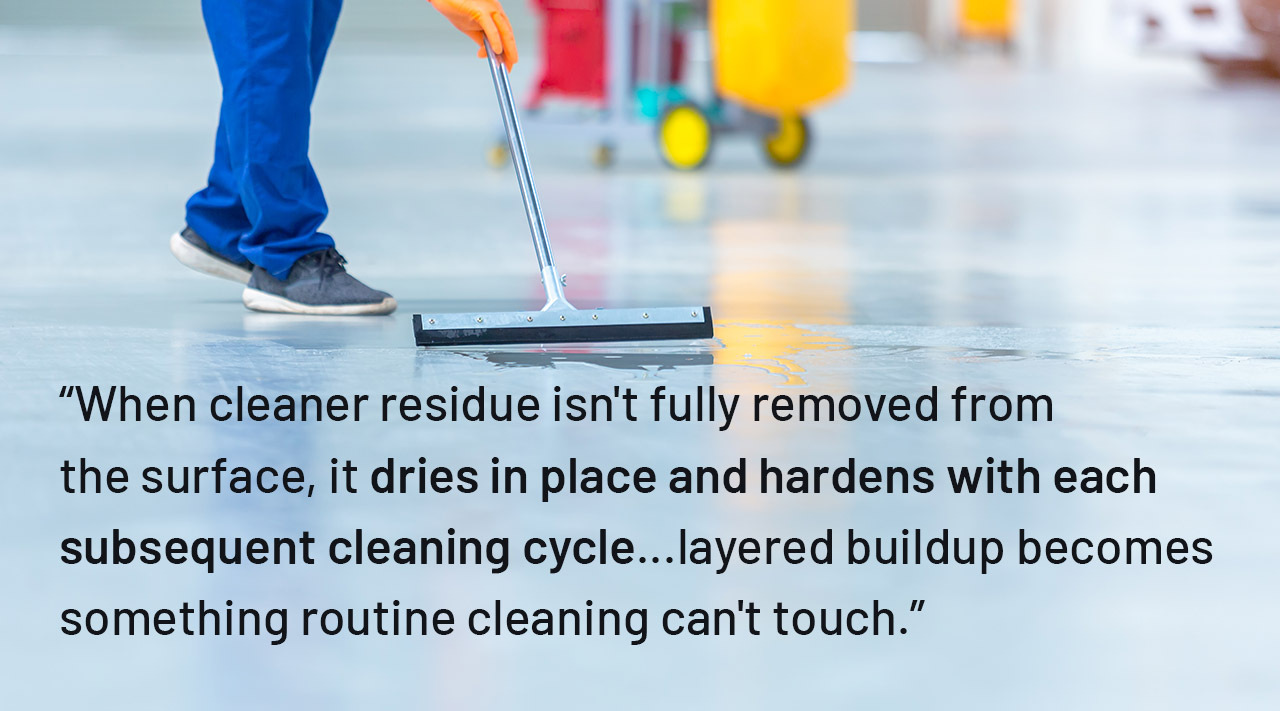
- Skipping the rinse pass allows cleaner residue to harden over repeated cleaning cycles until routine cleaning can't remove it.
- Running dirty equipment redistributes old buildup and soil, causing streaking and uneven finish even when dilution is correct.
- Using the wrong cleaner for the floor type creates chemical buildup that won't rinse clean, regardless of the technique or equipment.
- Inconsistent processes across shifts produce unpredictable results and uneven buildup that's difficult to diagnose and trace back to a single cause.
The fix for every one of these mistakes is the same: standardize the process, not the product.
Mistake #1: Using Too Much Cleaning Solution
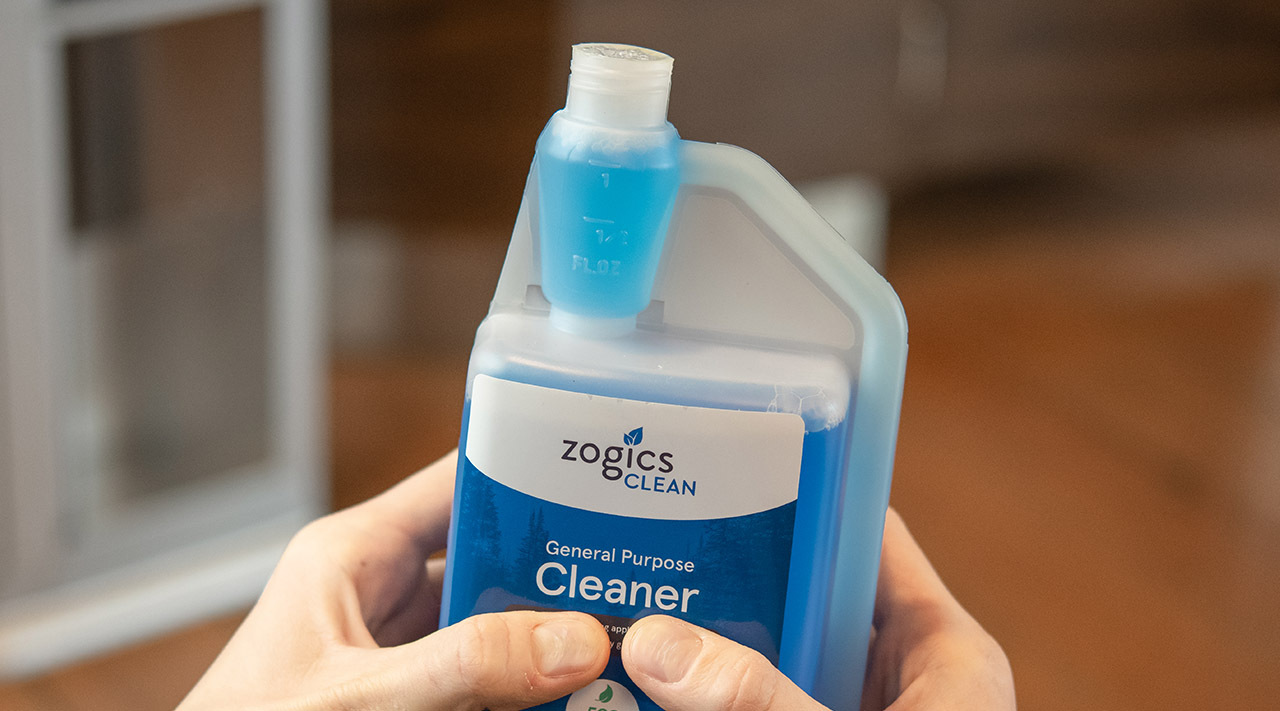
Using too much floor cleaner is one of the most common causes of sticky, filmy floors. When staff eyeball measurements instead of following the manufacturer's dilution ratio, excess detergent gets deposited on the surface with every pass. Instead of getting cleaner, the floor gets coated.
The cause: Staff estimating product amounts rather than measuring, often assuming more solution means better results.
The effect: Excess detergent leaves a film on the floor surface. That film attracts dirt, makes floors feel sticky, and speeds up re-soiling, so the floor looks dirty again faster after each cleaning.
Measure every time, and use measuring tools rather than guessing at the ratio. If your team isn't already doing this consistently, it's worth reviewing how to properly dilute commercial floor cleaners before adjusting anything else.
Mistake #2: Skipping the Rinse Pass
Skipping the rinse pass is a time-saving shortcut that creates a much bigger problem down the line.
The cause: Shift time pressure and the assumption that a single machine pass handles both cleaning and rinsing.
The effect: Residue that doesn't get rinsed off hardens progressively. After enough cycles, it bonds to the floor surface and requires a strip or deep clean to remove, which is far more labor-intensive than a rinse pass would have been.
Not every floor, cleaner, or situation requires a dedicated rinse step. But knowing when it does is critical. Review the full breakdown of whether you need to rinse floors after using a floor scrubber to make the right call for your facility.
Mistake #3: Running Dirty Equipment
A dirty floor machine redeposits what it's already collected instead of cleaning. Equipment condition is one of the most overlooked residue causes because it's invisible to the cleaning process itself. The machine runs, the floor gets wet, and it looks like cleaning happened. But if the machine is dirty, the floor is worse off than before.
The cause: Old solution left in tanks, worn or contaminated pads and brushes, and recovery tanks that recycle soiled water back onto the floor.
The effect: Streaking, uneven finish, and recurring residue, even when dilution ratios and rinsing steps are being followed correctly. If your process looks right on paper but the floors still streak, the machine is usually where to look.
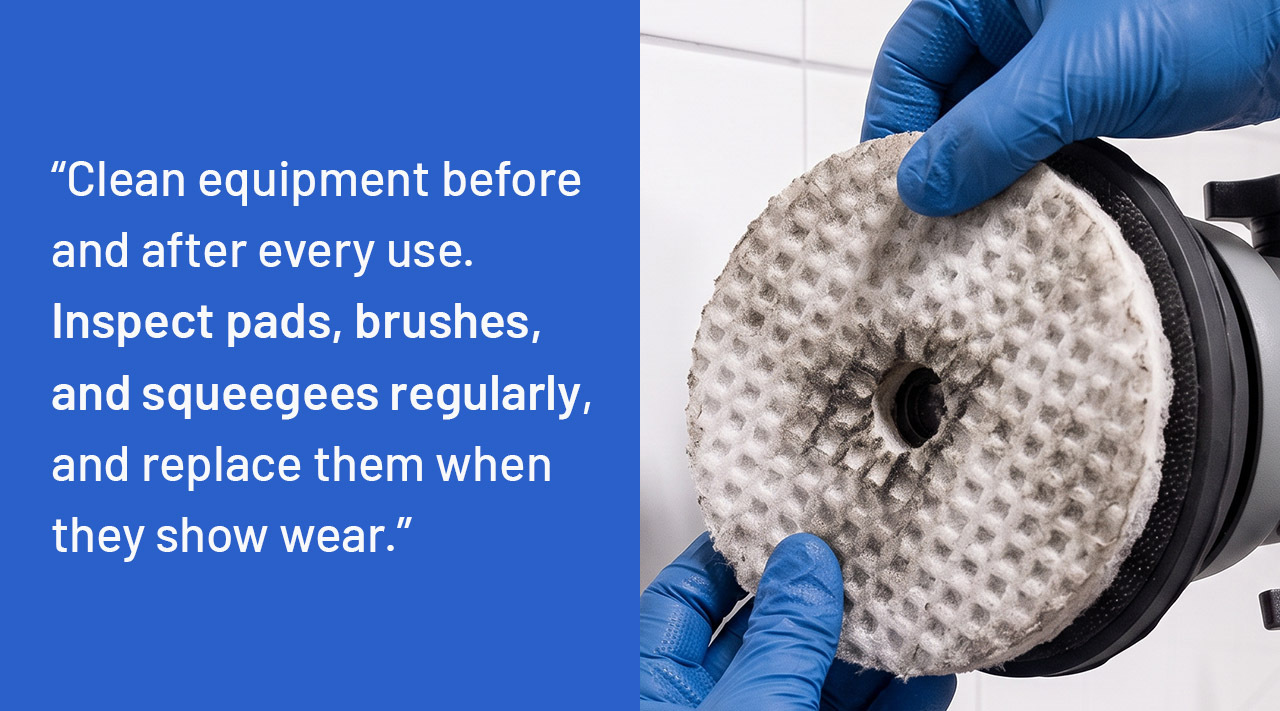
Clean equipment before and after every use. Inspect pads, brushes, and squeegees regularly, and replace them when they show wear. For a deeper look at how machine condition drives residue problems, see how dirty floor machines cause streaks and residue in commercial cleaning.
Mistake #4: Using the Wrong Cleaner for the Floor Type
Using the wrong cleaner for your floor type creates residue that no amount of technique or equipment can fix. The chemistry either bonds to the surface in a way it shouldn't, or it fails to lift soil the way a surface-appropriate formula would. The result is buildup that persists regardless of how well the rest of the process is executed.
The cause: Choosing a cleaner based on the cleaning task rather than the floor surface, or defaulting to a general-purpose product when the floor requires a specific formula.
The effect: Chemical residue that won't rinse clean, regardless of dilution accuracy, rinsing effort, or equipment condition.
Different floor types have specific chemistry requirements:
- VCT (vinyl composition tile): Requires a neutral pH cleaner. Alkaline products leave a haze that builds with each use.
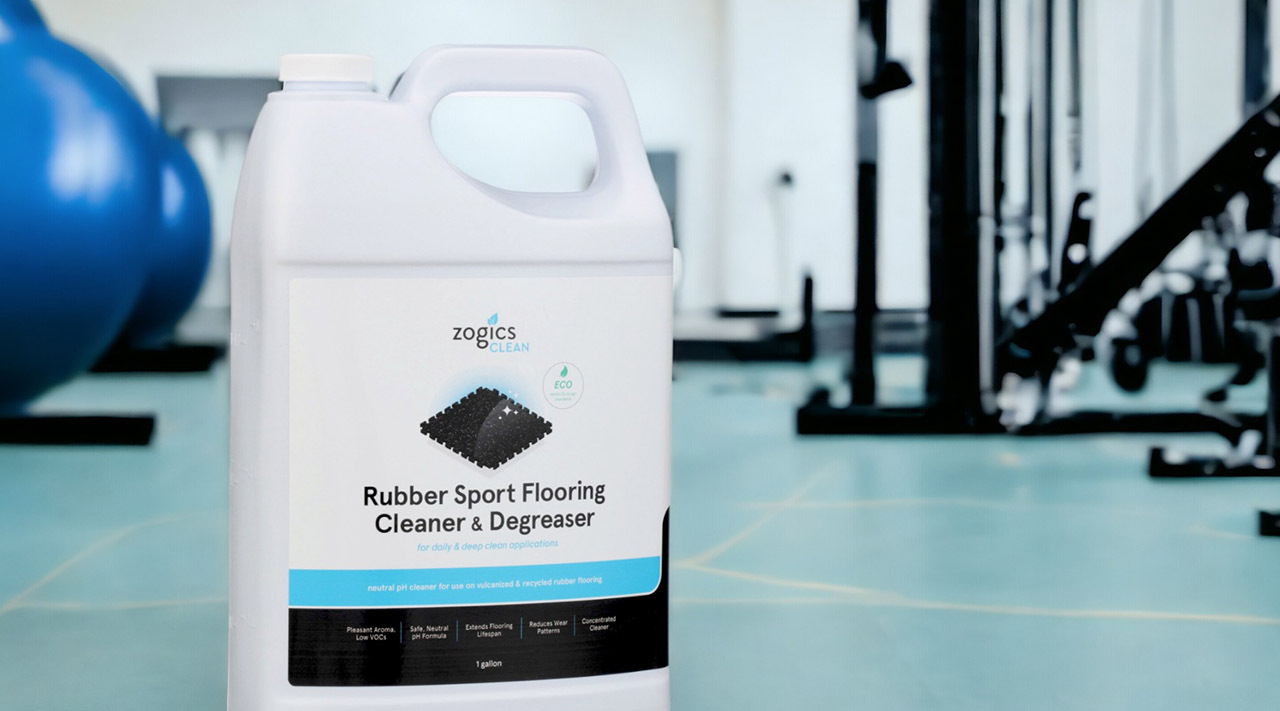
- Rubber flooring: Needs a rubber-safe formula. Standard degreasers can degrade the surface over time.
- Concrete: A porous surface where the wrong product can penetrate and bond rather than lift.
- LVT (luxury vinyl tile): Sensitive to high-alkaline cleaners. Residue bonds quickly and is difficult to remove.
Match the cleaner to the floor surface, not just the task. Browse our commercial floor cleaners to find formulas matched to specific floor types.
Mistake #5: Inconsistent Processes Across Staff and Shifts
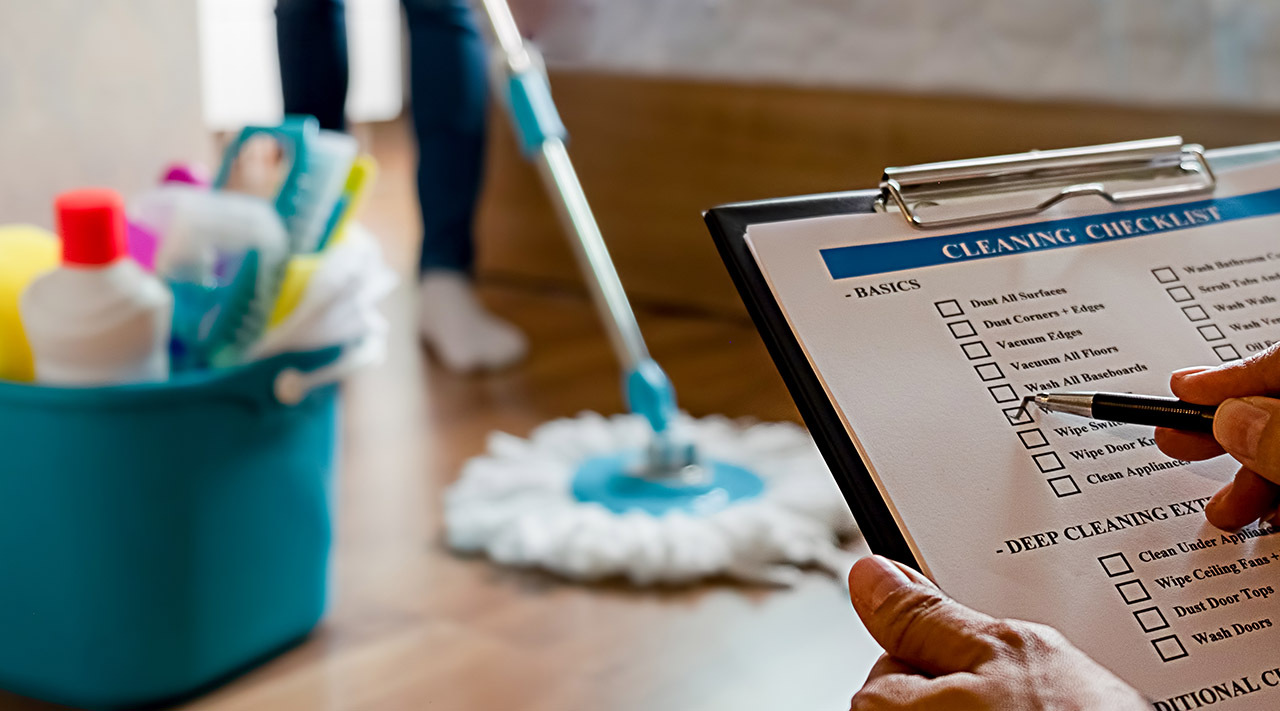
Inconsistent execution across staff and shifts is the most overlooked cause of residue buildup, and the hardest to diagnose. When one shift measures product correctly and another eyeballs it, when some staff rinse and others skip it, when equipment gets cleaned on some shifts but not others, the results are unpredictable and hard to trace back to any single cause.
The cause: No standardized protocol for dilution, rinsing, or equipment maintenance. Different staff bring different habits, and without a documented process, those habits vary by person and shift.
The effect: Floors that look clean one day and hazy the next. Buildup that accumulates unevenly across zones. Residue problems that persist even after correcting dilution or switching products, because the fix only applies to one shift's behavior.
The solution is standardized SOPs covering dilution ratios, rinse step requirements, and equipment cleaning procedures, along with staff training and accountability checkpoints to make sure the process is followed consistently. For the full prevention framework, see our guide on how to prevent residue buildup on commercial floors.
How These Mistakes Add Up Over Time
Each of these mistakes causes minor residue on its own. The bigger problem is what happens when they combine or repeat over time. Excess cleaner hardens because no one rinsed; the skipped rinse traces back to a rushed shift, and the machine spreads old buildup because the tank never got cleaned. The residue thickens with every cycle until routine cleaning can't touch it, and a strip and deep clean becomes the only option.
A consistent process is the only reliable prevention strategy. If your floors are struggling despite a regular schedule, the answer is almost always in the habits, not the products. Sticky floors after cleaning usually mean one or more of these mistakes is already building up.
Quick Reference: What Each Mistake Causes
Here's a summary of all five mistakes and the specific residue problem each one creates.
| Mistake | What It Causes |
|---|---|
| Using too much cleaning solution | Sticky floors, detergent film, faster re-soiling |
| Skipping the rinse pass | Residue that hardens over repeated cleaning cycles |
| Running dirty equipment | Streaking, uneven finish, residue redistribution |
| Wrong cleaner for floor type | Buildup that won't rinse clean regardless of technique |
| Inconsistent processes across shifts | Unpredictable results, uneven buildup across zones |
Frequently Asked Questions
How do you audit a commercial floor cleaning process for residue issues?
Start with dilution habits: confirm that staff is measuring product rather than estimating, and that the amounts match the manufacturer's recommended ratio. Next, verify whether rinse steps are being followed consistently, including which shifts perform them and which skip them. Then inspect equipment condition. Check solution tanks for old buildup, examine pads and brushes for wear or contamination, and confirm recovery tanks are being emptied and cleaned. After that, confirm the cleaner being used is appropriate for the specific floor surface in each area. Finally, check whether all staff follow the same protocol, or whether procedures vary by person or shift. Any gap in this checklist is a likely source of the residue problem.
Why does residue buildup show up in some areas but not others?
Uneven buildup across a facility almost always points to process variation, not product failure. The three most common causes are high-traffic zones that receive more cleaning passes and accumulate residue faster, different floor types across the facility that respond differently to the same cleaner, and inconsistent execution across shifts or cleaning zones. If one area consistently looks worse than another, the first question to ask is whether the same process is being applied in both places. In most cases, the answer is no, and the fix is process alignment, not a product change.
Can staff inconsistency cause floor residue even when the right products are used?
Yes. Good products don't compensate for inconsistent execution. If one staff member measures dilution correctly and another estimates, the floors cleaned by the second person will develop residue regardless of product quality. The same applies to rinse steps: a cleaner that requires a rinse pass will leave residue whenever that step is skipped, no matter how well formulated it is. Unmaintained equipment creates the same problem. Even the right cleaner at the right dilution will leave streaks if the machine is redistributing old buildup. A consistent process is what determines results, not the product alone.
When should a facility adjust its floor cleaning process instead of switching products?
If residue appears across multiple areas of the facility, if results vary noticeably by shift, or if problems persist despite using a cleaner that's appropriate for the floor type, the process should be reviewed before changing products. A clear decision rule: if the residue problem is inconsistent or hard to reproduce, it's almost always a process issue. Inconsistent problems have inconsistent causes, and that points to human variation, not chemistry. Switch products only after confirming that the dilution is accurate, the rinsing is consistent, the equipment is clean, and all staff are following the same protocol.
Recent Posts
-
 Your facility is on a regular cleaning schedule. The crew shows up, runs the machine, and the floors …Sep 24, 2026
 -
How Dirty Floor Cleaning Machines Cause Streaks and Residue in Commercial Cleaning
A floor scrubber leaving streaks or residue after cleaning is one of the most common complaints in …Sep 22, 2026 -

Why Commercial Floors Feel Sticky After Cleaning (And How to Fix It)
Sticky floors after mopping are a common complaint in commercial facilities. The floor looks clean …Sep 22, 2026